
IdeasWorking paper
XtremeLabs Engineering
The XtremeLabs AI Harness
How Much Engineering Is Enough to Make AI Work Reliable?
Written by Ahmar Abbas
Working Paper V26.11
An engineering framework, preliminary assessment and research agenda from XtremeLabs Engineering.
Download the PDFAbstract
Artificial intelligence has made producing software, instructional content and business documents remarkably inexpensive. Making that work reliable remains a different problem, and it is the problem this paper takes up.
Much of the current discussion around harness engineering focuses on coding agents. At XtremeLabs, the same problems arise in a broader range of work: developing instructor kits, creating simulations, building interactive exercises, producing customer quotations and running business operations. This paper describes the XtremeLabs AI Harness, an engineering standard for controlling how AI-generated work is produced, evaluated and released. It organizes the work into three risk-based tiers and six layers: guides, sensors, execution loops, memory, permissions and observability.
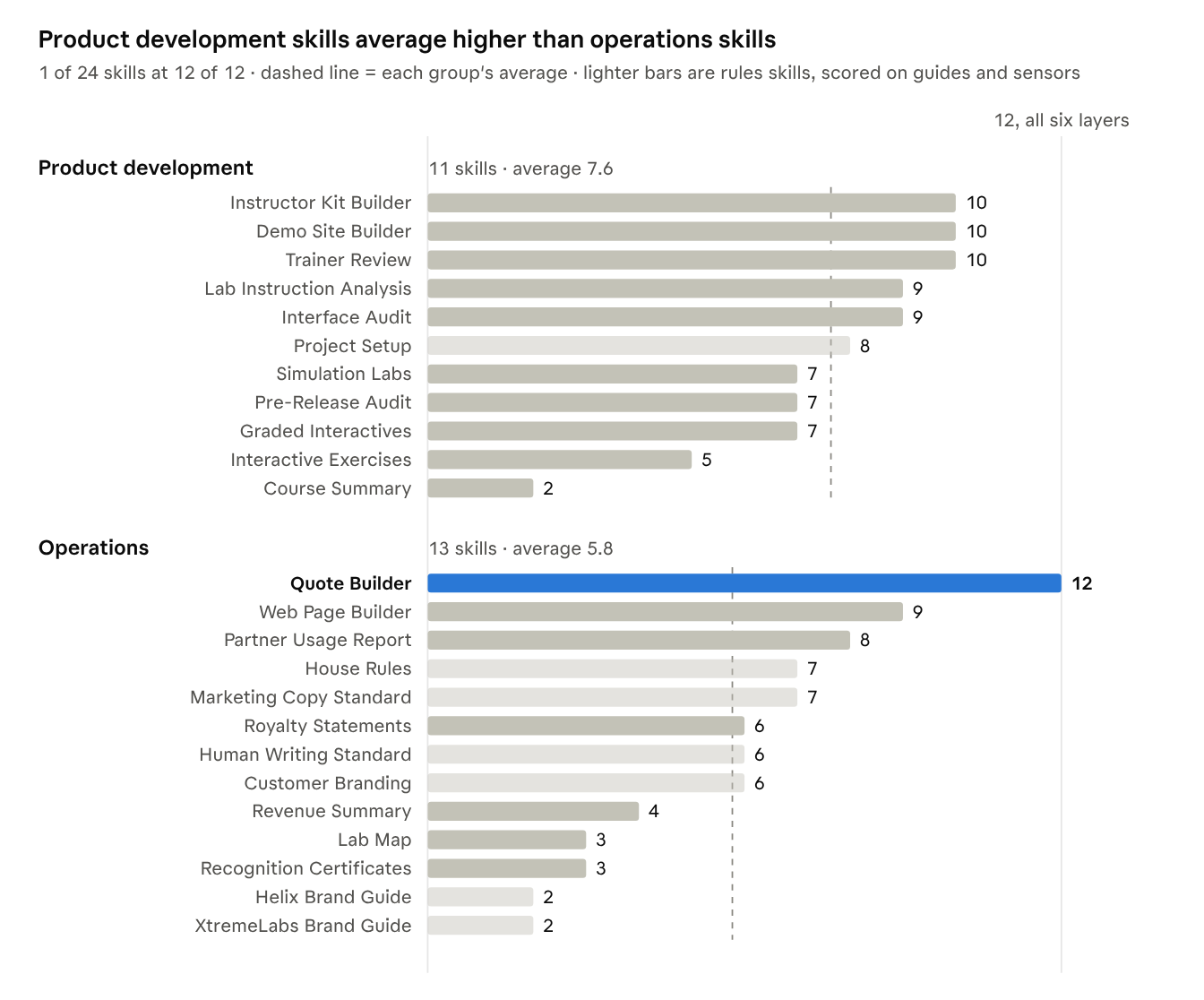
An initial assessment of 24 XtremeLabs AI skills found that only one, the Quote Builder, met every applicable requirement in the scoring framework. Product-development skills averaged 7.6 out of 12, while operations skills averaged 5.8, and persistent, reproducible state emerged as the weakest common area. These findings measure the completeness of documented engineering controls, not experimentally demonstrated improvements in reliability.
The paper argues that harness engineering should be treated as a risk and economics problem, rather than an exercise in adding more agents, instructions and checks. It presents the XtremeLabs standard as an initial implementation and proposes a program to measure its effects on correctness, rework, reproducibility and cost.
Keywords: AI agents, harness engineering, reliability, LLMs, evaluation, cross-model review, risk-based engineering, instructional technology
01Introduction: Producing Code and Content Is No Longer the Hard Problem
A better model does not fix a careless system. XtremeLabs builds with Claude and, increasingly, OpenAI models, and to make sure we were learning from our own efforts, we analyzed two dozen of the skills, applications and agents we have built. They support the development of instructor materials, simulations, interactive exercises, quotations, reports and customer-facing applications.
The timing is worth noting. Anthropic released Claude Code as a limited research preview on February 24, 2025,7 so agentic coding tools are approaching their second anniversary as this paper is written. In under two years they have gone from an experiment in a terminal to the way XtremeLabs builds products. The tools matured faster than the engineering practice around them, and that gap is the subject of this paper.
The experience has changed how XtremeLabs engineers think about producing software and content. Work that once required substantial programming or manual effort can now begin with a relatively short instruction and produce a useful result within minutes. But producing something useful and delivering something dependable are different achievements, and three incidents from XtremeLabs' own work illustrate the distinction.
In the first, an instructor-kit generator extracted lab information from an online store listing instead of using the authoritative lab files. The resulting material could appear complete while missing or misrepresenting the actual lab procedures.
In the second, an instructor guide was ready to go to a customer carrying the system's own build history: skill names and version numbers, source hashes, commit identifiers, review notes and a table of internal changes. An XtremeLabs live support agent caught it and stopped it before it reached the customer. The model had done what it was told. XtremeLabs' own standard required every file to carry its build details, and no automated check looked at what a customer would actually see. A person was the only sensor, and a person will not always be there. The fix was a required scan of every file in a kit before delivery, with the build record moved outside the files the customer receives.
In the third, a customer quotation risked using the price of an archived product, because the same course code returned several listings with different prices.
None of these incidents required a more capable language model to prevent. They arose because the surrounding system did not sufficiently specify which source to trust, what to check, which decisions to preserve or when to stop. This is the problem harness engineering attempts to solve.
The term has gained attention through work from Google, Anthropic, OpenAI and independent researchers.1,2,3,4,6 Much of that work concentrates on AI coding agents, but the underlying questions extend to nearly any workflow in which an AI system produces commercially consequential output. At XtremeLabs, those questions have become practical rather than theoretical. How should an AI system distinguish between current and archived product prices? How should it preserve a decision made several sessions earlier? How should an instructor kit be tested by something other than the system that produced it? How much verification is justified for a $50 internal task compared with a customer-facing application? Behind all of them sits one overarching question, which this paper sets out to explore.
How much engineering is enough to make AI-generated work reliable?
The answer is unlikely to be the same for every task, and much of what follows is an attempt to say how it should differ.
02From Model Capability to System Reliability
The model provides the ability to reason, interpret and generate. The harness supplies the conditions under which those capabilities operate. For XtremeLabs, it includes instructions, reference material, authoritative data sources, validation scripts, execution rules, persistent state, permissions and operational logs.
The distinction matters for two reasons. First, XtremeLabs does not control the underlying models. Claude and OpenAI models evolve independently of the systems built around them, and improvements in capability may eliminate some failure modes while introducing others. Second, the reliability of an application cannot depend entirely on a model remembering what it was told in a previous conversation. A correct pricing rule belongs in a durable specification or checking procedure, a security restriction belongs in enforceable permissions, and a calculation that can be verified independently should not depend solely on the model's judgment.
The harness is therefore the side of the AI system that XtremeLabs can own, version, audit and improve. Because it is written in plain files, it also works across models: either Claude or OpenAI can operate inside it, and either can check the other's work.
What existing research contributes
Several research and engineering efforts inform this approach. Anthropic's March 2026 work on long-running application development examines how planning, execution and independent evaluation can be separated, allowing agents to undertake more complex development tasks across multiple sessions.1 Google's Harness² research explores improving the runtime systems surrounding fixed language models, and provides evidence that changes to the harness can improve results without changing model weights.2 Google's September 2026 work on the anatomy of harness engineering emphasizes behavioral evaluation, iteration and guardrails.3 Birgitta Böckeler distinguishes between guides, which steer an agent before it acts, and sensors, which detect undesirable outcomes afterward.4
These ideas provide the foundation for the XtremeLabs approach, with one important qualification: more harness does not automatically produce better engineering. An October 2026 experiment published on Martin Fowler's site found that the benefits and costs of a behavioral harness varied with the capability of the underlying model, so the same additional controls did not provide equal benefits in every configuration.5 This is precisely why the economics of the harness deserve attention. The engineering objective is not to maximize the number of controls. It is to achieve an acceptable level of reliability at an acceptable cost.
03The XtremeLabs Approach: Risk Determines the Harness
XtremeLabs sorts AI work into three tiers by what a mistake would cost. Higher tiers carry more controls, and the tiers build on each other: H2 work must meet every H1 requirement plus its own, and H3 work must meet both.
| Tier | Risk profile | XtremeLabs examples |
|---|---|---|
| H1: Light | Internal, inexpensive to correct, limited external consequences | Revenue summaries, recognition certificates |
| H2: Standard | Customer-facing content, partner deliverables or financial calculations | Quotations, royalty statements, lab maps, partner usage reports |
| H3: Full | Customer products, complex long-running builds or agents capable of external actions | Instructor kits, customer applications, outreach and support agents |
The tiers are not measures of model intelligence. They are measures of engineering responsibility. A highly capable model generating a routine internal report may require only H1 controls, while the same model producing a contractual quotation needs stronger verification. When it can independently contact customers, modify records or publish material, the consequences change again. When classification is uncertain, the XtremeLabs standard initially applies the higher tier.
Why three tiers?
The three-tier structure is an engineering choice, not a universal taxonomy established by research. Its purpose is to prevent two opposite mistakes. The first is underengineering: deploying a consequential AI workflow without adequate validation, persistent state or permission controls. The second is overengineering: imposing expensive multi-agent evaluation, extensive logging and complicated orchestration on work where a simple checker would suffice.
Both consume resources, but only the first is usually recognized as a reliability problem. The guiding principle is proportionality.
Product development and operations
XtremeLabs also distinguishes between two categories of work. Product development covers systems that build, test or deliver the products customers use, including Helix content, labs, simulations, instructor kits, interactive exercises and applications. Operations covers the work surrounding those products, including sales, billing, reporting, marketing, document production and internal engineering standards.
The category establishes organizational responsibility, and the tier determines the minimum harness requirements. A quotation generator can be an H2 operations skill, while an outbound sales agent becomes H3 because it can take consequential actions outside the session.
04Six Layers of Engineering Control
The XtremeLabs AI Harness uses six layers. The first two draw on Böckeler's guides-and-sensors distinction.4 The overall six-layer structure adapts an independent practitioner framework published in August 2026, rather than originating as XtremeLabs research.6 Its contribution here is the adaptation to specific commercial workflows, risk tiers and acceptance requirements.
Guides: What the system reads before acting
Guides establish what the agent is expected to accomplish, which inputs it requires, which sources it may use and what constitutes acceptable output. At H1, instructions specify inputs, steps and output requirements. At H2, a structured intake file identifies required information and records rules learned from previous failures. At H3, application-level instructions, including an AGENTS.md file where applicable, provide a durable entry point for development agents. The objective is not to produce an enormous prompt. It is to eliminate important ambiguities before execution begins.
Sensors: How the system knows whether the work is correct
Sensors examine the result against defined requirements. For H1, this may be a checker script that confirms required fields, formatting or file structure. At H2, sensors extend to factual verification, financial recalculation, visual inspection and a review by a second model. At H3, an independent evaluator, running on a different model from the builder, tests the output as a customer or user would, against explicit acceptance criteria.
A checker should match the nature of the risk. Financial totals are better verified through deterministic calculation than by asking another language model whether the arithmetic looks correct, and an LLM evaluator may be appropriate for instructional clarity but cannot replace executable tests of application behavior.
Loop: How the system progresses and stops
A working harness needs rules for execution, correction and termination. At H1, a numbered process identifies the required steps, and missing essential inputs stop the run. At H2, checking and inspection steps must be specified before the result is delivered. At H3, work is divided into units with defined acceptance contracts, and failed units return for correction.
The XtremeLabs standard proposes a maximum of three correction rounds per unit and a spending cap, after which the system stops and explains the unresolved problem. The limit is an operating policy rather than a proven optimum, and future measurements may justify changing it. An important characteristic of a reliable system is its ability to stop when it cannot safely complete the task.
Memory: What survives the session
This layer addresses a recurring weakness in conversational AI workflows: a correction made during one session is not necessarily available during the next. XtremeLabs therefore treats persistent state as an engineering requirement rather than an optional convenience. For H1 work, naming and versioning establish which artifact was produced. For H2, a specification records the information and decisions required to reproduce the output. For H3, long-running applications retain progress records, decisions and version history.
The objective is reproducibility. Changing a customer's discount should mean changing the underlying quotation specification and regenerating the document, not asking an agent to reconstruct the previous conversation.
Permissions: What the system may do
The harness must distinguish capability from authority. An AI agent capable of sending an email is not necessarily authorized to send one, and an agent capable of modifying a database is not necessarily authorized to modify every record.
At H1, factual claims must be grounded in approved inputs or sources. At H2, commercial terms cannot be invented, and customer deliverables must not expose confidential internal information. At H3, consequential external actions require human approval, and operational limits are enforced in code, not solely through prompt instructions. Production applications must also satisfy relevant data-access and security requirements. The general principle is that the permission to generate an action is distinct from the permission to execute it.
Observability: What happened, what failed and what it cost
A system cannot be improved systematically if its failures cannot be reconstructed. At H1, the completion report identifies the output and detected problems. At H2, it records material assumptions, unresolved ambiguities, alternatives not selected and which model reviewed the work. At H3, applications track model usage, costs, significant calls, external actions and failures, with alerts where appropriate.
Logging must be balanced against privacy and security obligations, because more data is not automatically better observability. The goal is to understand what happened well enough to diagnose failures and measure improvement.
05Three Roles and Cross-Model Review
For H3 work, XtremeLabs separates planning, building and evaluation into three roles.
- Planner. Converts a request into a product-level specification.
- Builder. Implements the requirements.
- Evaluator. Tests the completed work against agreed criteria.
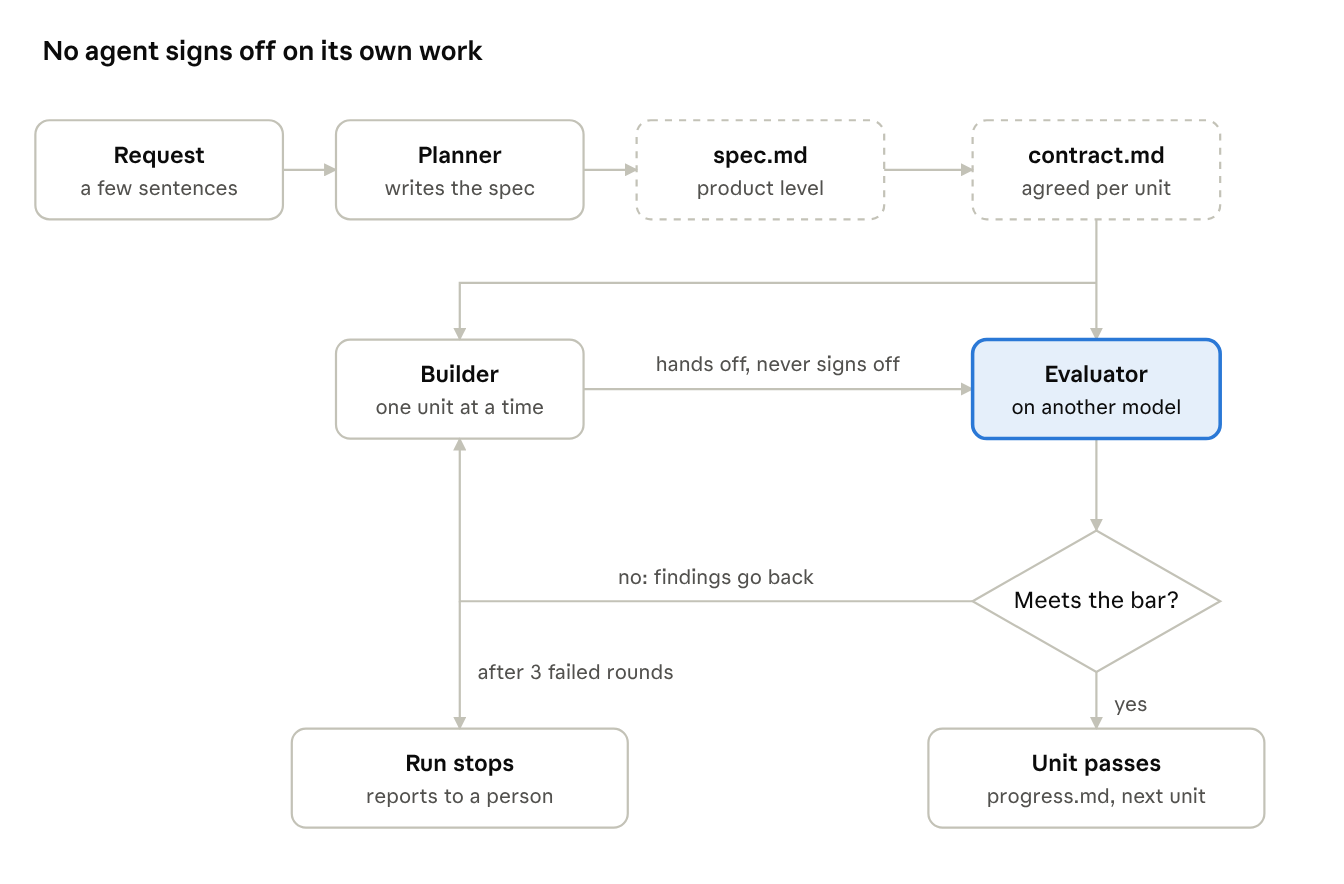
At H1 and H2, one agent may perform these functions, provided required deterministic checks remain in place. The distinction becomes more important as complexity increases. An agent that produces a result may also be inclined to interpret ambiguous requirements in a way that validates its own output. Independent evaluation reduces this particular conflict, although it does not eliminate shared assumptions or source errors.1
XtremeLabs routinely reviews across models. A Claude output is reviewed by an OpenAI model, and an OpenAI output by Claude. At H3 the evaluator always runs on the model that did not build the work, and at H2, customer-facing output gets one cross-model read before it ships. A second model is less likely to share the first one's blind spots, although it cannot correct errors in the sources both models read. A reviewer's finding is therefore treated as a claim to check against the source of truth, not as an instruction.
The Instructor Kit Builder and Trainer Review already implement an early version of this approach: the first produces instructional material, and the second examines it from the perspective of an independent Microsoft Certified Trainer. The Trainer Review has already caught errors that the builder passed as correct. One kit described an Azure virtual machine on Standard SSD as having no service-level agreement, when Microsoft publishes 99.5% for that configuration. Another taught a three-disk mirror as a three-way mirror, when Storage Spaces needs at least five disks for three-way mirroring, so three disks give a two-way mirror. A third scheduled a teaching day of eight contact hours with one break and no lunch. Each would have reached an instructor standing in front of a class. The proposed next step is to establish explicit, measurable acceptance criteria and make the review a required release gate.
06The Ratchet: Turning Failures into Durable Improvements
One of the more consequential lessons from XtremeLabs' experience concerns the way AI mistakes are corrected. In conventional software development, a recurring defect is generally addressed through a change to source code, a test or both. Conversational AI work can develop a less durable habit: correcting the model within a session and assuming the problem has been resolved. The XtremeLabs ratchet rule attempts to prevent this.
When a failure occurs, the engineering process determines which durable change it requires:
- A change to a guide or authoritative reference.
- An automated check that detects the failure.
- A recorded decision or specification that survives future sessions.
The change log identifies the failure and the corrective control, and a mistake that the cross-model reviewer keeps catching is a signal that one of these three changes is overdue. Not every mistake deserves another rule, though. Excessive instructions create their own complexity and can conflict with one another, so the appropriate response is the smallest durable change that addresses the identified failure and passes relevant regression checks.
Sources of truth
XtremeLabs maintains an explicit source hierarchy for frequently used information.
| Information | Authoritative source |
|---|---|
| Product listings, prices, customers and orders | Live XtremeLabs store |
| Lab content and procedures | Official course lab files |
| Microsoft technical claims | Current Microsoft Learn documentation |
| End-user terms | Current agreement linked from the corporate website |
| Brand requirements | Approved XtremeLabs and Helix brand guides |
| Naming and writing standards | House Rules and Human Writing Standard |
An agent must not substitute its own memory for an authoritative source, and when two models disagree, the source settles it. Where a required source cannot be accessed, the system reports that limitation and stops the affected workflow rather than inventing the missing information.
07Case Study: The Quote Builder
The Quote Builder provides the clearest current example of the standard in practice. It converts a customer pricing request, whether received as text, an email or an image, into a two-page quotation PDF. The workflow requires more than document generation: a quotation must identify the correct products, retrieve current prices, distinguish active listings from archived ones, calculate totals accurately and present commercially appropriate terms.
In one observed case, the same course code, MS-4004, returned an archived lab priced at $11.69 and an active lab with a Copilot license priced at $29.60. A model relying on incomplete context or remembered information could select the wrong listing. The Quote Builder addresses that risk through a documented intake process, source-selection rules, live pricing retrieval, independent calculations, writing checks, visual inspection and a persistent specification, and its workflow stops when essential customer, product or quantity information is missing.
Under the XtremeLabs assessment framework, it receives 12 out of 12 points across the six layers. This does not demonstrate that the Quote Builder has a zero-error rate, or that its harness outperforms a simpler alternative; those questions require testing against representative quotation requests. What the score establishes is that the assessed engineering controls are present, which makes the Quote Builder a useful reference implementation and a candidate for controlled comparison.
08Where XtremeLabs Stands: An Initial Assessment
On November 21, 2026, XtremeLabs assessed 24 of its AI skills against the six-layer standard.8 Each layer received a score of zero, one or two:
- 0: Required controls absent.
- 1: Controls partially implemented.
- 2: Applicable requirements implemented.
The maximum score was 12. The inventory included 11 product-development skills and 13 operations skills.
| Measure | Result |
|---|---|
| Skills assessed | 24 |
| Product-development skills | 11 |
| Operations skills | 13 |
| Average product-development score | 7.6 / 12 |
| Average operations score | 5.8 / 12 |
| Skills scoring 12 / 12 | 1 |
| Weakest common layer | Memory |
The Instructor Kit Builder, Demo Site Builder and Trainer Review each scored 10, and the Quote Builder was the only skill to meet all assessed requirements. Several regularly used generators lacked automated checkers, including revenue summaries, lab maps, course summaries, recognition certificates and interactive exercises. The assessment also identified persistent state as a widespread weakness: many workflows can produce an acceptable result in one session but do not retain a complete specification that permits reliable regeneration.
What these scores mean
The scores measure the presence and completeness of engineering controls. They do not measure accuracy, customer satisfaction, financial benefit or actual failure rates. A score of 12 means that a system satisfies the requirements assigned to its tier, not that its outputs are always correct.
The category averages also require qualification. Some operations skills are reference guides rather than independent execution systems, and their inclusion lowers the operations average, making a direct comparison with product-development generators potentially misleading. The assessment was based on reviewing instructions and scripts. It was not a controlled experimental evaluation, and an independent second assessment has not yet been conducted. These limitations matter because the purpose of a working paper is to distinguish observations from conclusions.
What the assessment does establish
The assessment does identify concrete engineering gaps. Several skills lack automated checks, many lack persistent specifications, and some complex workflows have not yet made independent evaluation a mandatory release condition. These findings provide an actionable baseline and a way to prioritize improvements, although they do not yet establish the economic return on those improvements.
09The Economics of Reliability
This is the central question the XtremeLabs framework is intended to address. An additional evaluator can detect mistakes, but it also incurs costs. A persistent specification can reduce future rework, but it also requires implementation and maintenance. A more elaborate workflow may reduce failures while increasing execution time and introducing additional points of failure. The economically relevant measure is therefore not simply the cost of generating an output. It is the cost per accepted, usable output, including generation, verification, correction and human intervention.
A second measure should account for the consequences of failures that escape detection, because not all mistakes have equal costs. A formatting error in an internal certificate may take minutes to correct. An incorrect commercial quotation may damage a customer relationship.
This is why the risk classification matters. The framework predicts that additional harness controls should be more economically valuable where the consequences of undetected errors are higher. That is a hypothesis, not an established result.
The risk of overengineering
Harness engineering can become self-defeating when controls are introduced without demonstrating their value. An agent may spend more time planning and checking a simple task than completing it. Additional models may disagree without producing a better outcome, and more elaborate state management may create unnecessary maintenance obligations. For this reason, XtremeLabs does not regard the H3 architecture as a universal ideal, and the objective is not to move every skill toward maximum complexity.
The objective is to apply the least expensive set of controls that achieves an acceptable level of reliability.
10What XtremeLabs Will Test Next
The next stage is to move beyond scoring controls and begin measuring their effects. Selected XtremeLabs workflows provide an opportunity to compare existing implementations with stronger harness configurations, and four measurements will form the initial evaluation.
- Correctness. How often does an output satisfy independently established factual, functional and presentation requirements?
- Rework. How many revisions or human interventions are needed before acceptance?
- Reproducibility. Can the system recreate a previously accepted result from its recorded specification and source versions?
- Cost. What is the total financial and human effort required per accepted output?
For agents with external authority, additional measurements will address permission violations, incorrectly executed actions and the effectiveness of approval requirements. The first comparisons should use representative tasks and the same acceptance criteria across configurations, and they should distinguish improvements caused by changes to the harness from those caused by changing the underlying model. Three hypotheses will guide the work.
- H1: Persistent specifications reduce rework. Systems that retain structured inputs and decisions will require less reconstruction when a task is revised or repeated.
- H2: Independent evaluation improves acceptance rates for complex output. The benefit will be greater for instructional content and applications than for simple deterministic documents. A cross-model evaluator will be compared with a same-model evaluator on the same tasks.
- H3: The economic value of additional controls increases with the consequences of failure. Stronger harnesses will be easier to justify for H2 and H3 workflows than for low-risk H1 tasks.
These are testable propositions. None should be accepted solely because it appears consistent with engineering intuition.
11Implications for Technical Training
XtremeLabs' work provides a particular perspective on reliability, because technical training is concerned with more than producing correct-looking information. A lab can be technically accurate and still be difficult to follow. A simulation can execute successfully without testing the intended skill. An instructor kit can contain all the required sections while failing to prepare an instructor for the questions students are likely to ask. These are not merely content-generation problems. They are problems of validation against instructional objectives.
The separation between builder and evaluator is consequently relevant to technical training. A system generating a lab should not be the sole authority on whether the lab is effective. The evaluation needs to consider technical accuracy, task completion, clarity, prerequisites, instructional alignment and the actual experience of a learner or instructor. XtremeLabs is applying this principle internally through its Instructor Kit Builder and Trainer Review.
The same pattern may eventually have value for customers using Helix to develop and deliver instructional content. That commercial possibility remains distinct from the engineering findings presented in this paper, and the immediate objective is to establish whether independent evaluation improves outcomes in XtremeLabs' own production workflows.
12Conclusion: Reliability Has to Be Engineered
The economics of producing software and content have changed rapidly. AI systems can generate code, documents, instructional materials and working applications with far less direct human effort than was required only a short time ago. The reduction in production effort does not eliminate engineering responsibility. It changes where that responsibility is concentrated, and increasingly the challenge is to establish whether generated work is correct, reproducible, authorized and economically useful.
The XtremeLabs AI Harness is one attempt to formalize that work. It establishes three risk-based tiers, six engineering layers, a separation of planning, building and evaluation for complex systems, and routine review across models. The initial assessment of 24 skills identifies meaningful gaps, particularly in automated checking and persistent state, and provides a baseline against which subsequent changes can be measured.
The framework is not presented as a universal answer. Its thresholds, scoring system and implementation choices reflect XtremeLabs' current needs and experience, and their effectiveness remains to be demonstrated. The next question is whether implementing these controls produces measurably better outcomes, and at what cost. The broader proposition is that as producing software and content becomes cheaper, the engineering discipline surrounding it becomes more important. But that proposition carries an obligation: the harness itself must be evaluated.
13References
- 1Rajasekaran, P. (2026). Harness design for long-running application development. Anthropic, March. anthropic.com/engineering/harness-design-long-running-apps
- 2Xu, R., et al. (2026). Harness²: Recursive Agent Harnessing for an Open World. arXiv:2610.14224.
- 3Mullen, T., & Gunderman, C. (2026). The Anatomy of Harness Engineering: How to Evaluate, Iterate, and Guard AI Coding Agents. Google Developers Blog, September.
- 4Böckeler, B. (2026). Harness engineering for coding agent users. martinfowler.com, 2 April.
- 5Are Harnesses Worth the Cost? (2026). martinfowler.com, 13 October.
- 6Harness Engineering: Agent = Model + Harness, the Six-Layer Production Playbook. (2026). Independent practitioner synthesis, August; not affiliated with Google.
- 7Anthropic. (2025). Claude 3.7 Sonnet and Claude Code. 24 February.
- 8XtremeLabs LLC. (2026). Internal AI Skills Inventory and Harness Assessment. 21 November. Unpublished internal assessment.